
EACOP: route, design and project status
- 1,443 km pipeline from Hoima (Uganda) to Tanga (Tanzania).
- Because Uganda’s crude is viscous and waxy, the pipeline will be heated along its entire length, making it the longest electrically heated pipeline.
- Key approvals and studies: IGA signed May 2017; FEED approved Oct 2020; ESIA certified Dec 2020; RAP approved with implementation ongoing.
- Commercial steps: HGAs, SHA and TTA signed Apr 2021; project finance targeted at 60:40 debt–equity and conditional letters of award issued for critical contracts.
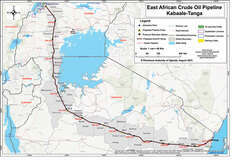
Route and design
The East African Crude Oil Pipeline is a 1,443 km transboundary export pipeline starting in Hoima District, Uganda and terminating at a marine export terminal north of Tanga port on the Chongoleani peninsula in Tanzania. Within Uganda it covers 296 km across ten districts, 25 sub-counties and 171 villages; in Tanzania it traverses eight regions and 20 districts. The route was selected by the Government of Uganda as the least-cost and most robust.
Because Uganda’s crude is viscous and waxy, the pipeline will be heated along its full length, requiring electrical heating and making it the longest electrically heated pipeline. The pipeline will be buried where possible, with some above-ground facilities engineered to minimise environmental and social impact.
Permits, studies and social measures
The Inter-Government Agreement was signed in May 2017. Front-End Engineering Design (FEED) was completed and approved by the Petroleum Authority of Uganda in October 2020. The Environmental and Social Impact Assessment studies were approved and certified by NEMA in December 2020. A Resettlement Action Plan has been completed and approved by the Chief Government Valuer, with implementation ongoing.
Commercial structure and financing
Host Government Agreements for Uganda and Tanzania, the Shareholders Agreement and the Tariff & Transportation Agreement were signed in April 2021 to establish the commercial and legal framework. The project is structured for project finance at a 60:40 debt–equity ratio and lenders are being approached to raise the debt component.
Execution and procurement
Conditional Letters of Award have been issued for critical packages — early civil works (Lot 2 in Tanzania), electrical, instrumentation and telecoms, pipeline construction, above-ground installations, tanks EPC, jetty EPC, terminal EPC and thermal insulation/coating — to de-risk the execution schedule. Detailed engineering and alignment optimisation are ongoing.
Source: unoc.co.ug