
CATL opens world’s largest energy-storage testbed for real-world validation
- RMB 3 billion investment on a 10-hectare Xiamen testbed providing open, station-level energy storage validation
- Grid Integration Lab: 35 kV/100 MVA simulator with real-time emulation, can test over 10 containers, simulate 1,000-node grids and 15–60 Hz conditions for station-level grid-forming and multi-unit coordination
- Facility hosts specialized labs: High-Voltage Safety (1 kV–500 kV), Thermal Safety & Combustion (20 MW calorimeter, 100,000 m3, nine-container testing), Environment Reliability (−50°C to 100°C, up to 7,200 m altitude) and EMC (40-ft container capacity, 65-ton turntable, 5 MW)
- ESVL offers multi-witness certification services with TÜV SÜD, TÜV Rheinland, CGC and CSA; CATL reported 121 GWh energy storage battery sales in 2025 (30.4% global market share)
Overview
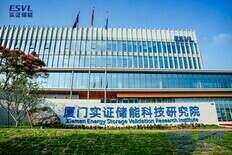
CATL's Xiamen Energy Storage Validation Research Institute (ESVL) began operations on May 28, 2026; the 10-hectare, RMB 3 billion facility is an open, shared station-level testing platform for the energy storage sector.
Need for station-level validation
The industry faces a performance gap: nearly 1 in 5 large-scale energy storage sites underperform and 46.5% of systems encounter grid-connection delays over two months; current validation is largely component- and scenario-based, creating demand for full-system, station-level verification of safety, grid support and long-term reliability before deployment.
Core laboratory capabilities
Five specialized labs provide full-scenario testing: Grid Integration Lab with a 35 kV/100 MVA simulator and real-time emulation (can test 10+ containers, simulate 1,000-node grids and 15–60 Hz conditions) for station-level grid-forming and multi-unit coordination; High-Voltage Safety Lab covering 1 kV–500 kV for withstand, partial discharge and extreme-voltage failure analysis; Thermal Safety & Combustion Lab with a 20 MW calorimeter and 100,000 m3 indoor space for up to nine-container explosion testing; Environment Reliability Lab with climate, salt-spray, rain and sand chambers (−50°C to 100°C, simulated altitudes to 7,200 m); and an EMC Lab able to house a 40-ft container with a 65-ton turntable and 5 MW supply for high-power anechoic testing.
Certification and track record
ESVL offers multi-witness testing with TÜV SÜD, TÜV Rheinland, CGC and CSA. CATL notes prior technology development since 2016, a 30 MW/108 MWh deployment in Jinjiang, international projects in Australia and North America, and 2025 battery sales of 121 GWh (30.4% global market share).
Source: CATL