
BASF’s industrial Cathedral and the ground it stands on
- BASF's Ludwigshafen Verbund delivers roughly €1 billion/year in cost advantage and underpins around 100,000 patents and sustained R&D investment.
- Ammonia synthesis—powered by natural gas—is highly energy‑intensive, and the 2022 spike in European gas prices (10–15x) forced widespread curtailments that disrupted downstream nitric acid, caprolactam and MDI/TDI precursor chains.
- BASF curtailed Ludwigshafen production in 2022, announced structural workforce reductions, and is restructuring the site while expanding the Zhanjiang Verbund.
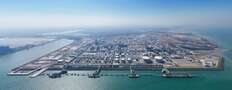
There is a moment in any serious study of BASF's Ludwigshafen complex when admiration becomes something closer to awe. What the company has built over more than a century is not simply a large chemical site. It is an argument, a physical, operational argument, that industrial rationalism can impose genuine order on the chaos of chemistry: waste heat captured, byproduct streams valorized, feedstock atoms passed from reactor to reactor until almost nothing is surrendered to entropy.
The philosophy has a name. The Verbund; from the German for network, connection, composite, routes the output of one plant as the feedstock of the next. Steam generated in one unit heats a neighbor. Off-gases that would otherwise flare become raw materials. CO₂ generated internally finds synthesis pathways rather than a stack. The result, across Ludwigshafen and BASF's other integrated sites, is a cost advantage the company has estimated at roughly one billion euros annually at Ludwigshafen alone. It is not a marketing claim. It is the arithmetic of a system that genuinely closes its loops.
This is the other side of the coin from the chemical park model, where independent tenants share infrastructure: steam, power, waste treatment, under an operator's umbrella, but run their own profits and losses, buy feedstocks at market prices, and sell products externally. The park tenant has no illusions of systemic optimization. The Verbund makes a bolder bet: that the system as a whole can be made more rational than the sum of its parts.
For roughly four decades, in the stable energy environment that prevailed across most of the post-war period, that bet paid out continuously. The efficiency rents compounded. They funded the science; around 100,000 patents, a research budget few national chemistry programs can match. They funded the acquisitions, the talent, the global network. The cathedral rose, and it was genuinely beautiful.
The vulnerability of the Verbund is the precise mirror of its strength. Tight integration that eliminates cost in normal conditions becomes a transmission belt for shocks when the underlying assumptions change. The ammonia cascade of 2022 made this visible with uncomfortable clarity.
Ammonia synthesis is one of the most energy-intensive processes in chemistry. Natural gas serves both as the hydrogen source and as the fuel. When European gas prices spiked to ten or fifteen times their historical average following Russia's invasion of Ukraine, ammonia production became economically untenable at many European sites. At a conventional plant in a chemical park, this is painful but contained. The plant curtails, the neighbors are largely unaffected.
In the Verbund, ammonia is not simply a product. It is a node in a web that feeds nitric acid, caprolactam, MDI and TDI precursor chains, and a range of nitrogen chemistry intermediates. When the node stresses, the web stresses with it. Plants downstream cannot simply source replacement ammonia from the spot market and maintain the same cost basis — the entire economic logic of the system assumes internal transfer pricing, not market rates for every intermediate. BASF curtailed significant production at Ludwigshafen in 2022 and subsequently announced structural workforce reductions. The language in their public statements was notably candid: this was not a temporary squeeze. It was a structural challenge to the site's long-run competitiveness.
The Verbund site map looks like mastery. For a long time, the quarterly reports confirmed mastery. And then a pipeline war turned a valve.
None of this is an argument against the Verbund. That would be too simple, and too cheap. The counterfactual matters: what would BASF's cumulative position look like as a collection of independent park tenants rather than an integrated system? The answer is almost certainly considerably weaker; in science, in market reach, in the capacity to absorb decades of normal operational turbulence, which the Verbund handles better than modular alternatives precisely because of its internal rerouting options and buffer structures. The resilience failure is specifically to civilizational-scale external shocks, not to the ordinary contingencies of industrial life.
The honest assessment is this: the Verbund represents perhaps the most complete expression of industrial rationalism ever attempted; a system in which nothing is wasted because everything is foreseen. Over forty years of ideal-world conditions were not an illusion. The value extracted was real, and it compounded in ways that a less integrated structure could not have matched.
The question the energy crisis posed was not whether the Verbund was a mistake. It was whether a system calibrated to one era can adapt its fundamental logic to another without dismantling what made it valuable in the first place. BASF's answer: restructure Ludwigshafen, expand Zhanjiang, is a displacement of the philosophy rather than a revision of it. The Verbund moves to where the ground is currently stable. Is it wisdom? Who knows. But it may be the most rational response available to a company whose identity is inseparable from the cathedral it built.
Cathedrals, after all, were not built to last forever. They were built to outlast the people who needed them most; and most of them did.