NEDO and partners achieve 85% ammonia co‑firing in naphtha cracking furnace
- Test furnace reached an ammonia co‑firing rate of 85% on a calorific basis for the entire naphtha cracking furnace.
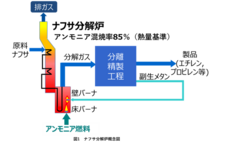
- Floor burner operated at 100% dedicated ammonia combustion while wall burners used naphtha cracking off‑gas (methane).
- NOx emissions were confirmed to be at the same level as existing equipment despite high ammonia share.
- Project launched in FY2021 under NEDO Green Innovation Fund, with planned duration through FY2030 and plans to pursue 100% ammonia combustion.
Background
Naphtha cracking furnaces thermally decompose naphtha to produce basic chemicals such as ethylene and propylene and are major CO₂ sources in petrochemical complexes. These furnaces typically burn off‑gas (mainly methane) for heat; replacing that fuel with ammonia—which does not emit CO₂ on combustion—can cut combustion CO₂ emissions.
Test programme and technology
Since FY2021, Toyo Engineering, Mitsui Chemicals, Maruzen Petrochemical, Sojitz Machinery and NEDO have developed ammonia combustion technology for naphtha cracking furnaces under the Green Innovation Fund project. Two burner types were developed: a floor burner responsible for main heat supply and a wall burner for flame shaping and temperature control.
Results
In test furnace operation the floor burner ran at 100% dedicated ammonia combustion while wall burners used existing off‑gas (methane). The project achieved an ammonia co‑firing rate of 85% on a calorific value basis for the entire furnace—the highest reported level to date—and confirmed NOx emissions at the same level as existing equipment.
Next steps
Partners will apply ammonia to the wall burner and pursue 100% dedicated ammonia combustion for the entire furnace, and advance demonstrations toward commercial‑scale application to support petrochemical decarbonization and stable supply of basic chemicals. The project period is FY2021–FY2030 (planned).
Source: TOYO