
Petrobras to invest $450M in world's largest seabed seismic monitoring project
- US$450 million investment to install a permanent reservoir monitoring (PRM) seabed sensor network in the Mero field, Santos Basin.
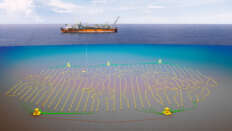
- Phase 1: over 460 km of optical seismographic cables across 222 km² installed; first data collection slated for Q2 2026.
- Phase 2: an additional 316 km of cables covering 140 km² for Mero 3 and 4, due for completion next year.
- Project partners include Petrobras and Libra Consortium (Shell, TotalEnergies, CNPC, CNOOC, PPSA); system will track oil, gas and water movement and employ AI with UFRJ.
Overview
Petrobras and Libra Consortium partners will invest US$450 million to deploy a permanent reservoir monitoring (PRM) seabed sensor network in the Mero field, Santos Basin, to map subsoil geology and fluid flow (oil, gas, water) and support reservoir management and recovery; Mero averaged over 680,000 barrels per day in January 2026.
Infrastructure and schedule
Phase 1—more than 460 km of optical seismographic cables covering 222 km²—was completed in March; first data collection is planned for Q2 2026. Phase 2 adds 316 km of cables across 140 km² for Mero 3 and 4 and is due for completion next year.
Operations and data handling
Initially, platform onboard computers will receive and process subsea sensor data for the FPSOs Guanabara (Mero 1) and Sepetiba (Mero 2) and the areas serving Duque de Caxias (Mero 3) and Alexandre de Gusmão (Mero 4); data transmission to corporate headquarters via fiber optics is planned in a later stage.
Analytics and partners
Petrobras will apply AI in partnership with UFRJ to continuously analyze PRM data for scientific research and operational safety. Consortium stakeholders include Petrobras (operator), Shell Brasil, TotalEnergies EP Brasil, CNPC, CNOOC Petroleum Brasil and PPSA as production-sharing contract manager.
Source: Petrobras