
Sekisui House Launches Japan's First Circular Window Glass Recycling Project
- The demonstration project starts in the Kansai region from March 2026.
- Window glass will be recycled into new glass of equivalent quality.
- Over 500,000 tons of waste window glass are generated annually in Japan.
- Recycled cullet can be melted at lower temperatures, reducing emissions.
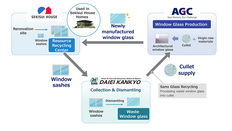
Project Overview
Sekisui House, Daiei Kankyo, and AGC are launching a demonstration project in the Kansai region starting March 2026. The initiative aims to establish a circular model for recycling window glass from home renovations into new architectural glass of equivalent quality.
Current Challenges
Japan generates over 500,000 tons of waste window glass annually from building demolitions and renovations. Most of this waste is currently landfilled or downcycled into lower-quality applications, rather than being recycled back into window glass.
Project Goals
The project seeks to advance resource circulation by enabling closed-loop recycling of window glass, reducing industrial waste and landfill volume, conserving virgin raw materials, and lowering greenhouse gas emissions. Recycled cullet can be melted at lower temperatures compared to newly extracted raw materials, contributing to these environmental benefits.
Roles and Collaboration
In this project, Daiei Kankyo will dismantle the recovered discarded sashes, and a specialized glass recycler will process the window glass into high-purity cullet. AGC will use this cullet to manufacture new architectural window glass that meets the same quality standards as products made from virgin materials. Sekisui House will adopt the newly manufactured window glass in its housing products, demonstrating a pathway to reduce environmental impact across the entire lifecycle of homes.
Future Implications
The collaboration aims to develop an effective and scalable model that can be applied with a broader range of waste generators in the future, advancing resource circulation and contributing to a circular economy.
Source: AGC