
Recycling Tires into Automotive Plastics: Neste, Borealis, Covestro Collaborate
- Neste, Borealis, and Covestro signed a project agreement to recycle discarded tires into high-quality automotive plastics.
- Tires are chemically recycled into base chemicals phenol and acetone, then processed into polycarbonates.
- The first products from this collaboration are already available, with potential expansion to polyurethanes.
- Recycled content is tracked via mass balancing and ISCC Plus certification.
Project Agreement
Neste, Borealis, and Covestro have signed a project agreement to recycle discarded tires into high-quality plastics for automotive applications. This collaboration aims to enhance circularity in the plastics value chain and the automotive industry.
Chemical Recycling Process
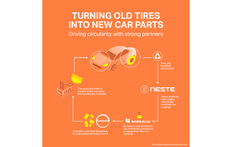
Discarded tires are liquefied through chemical recycling, processed into base chemicals, and further refined into high-purity polycarbonates. These polycarbonates can be used in various automotive applications, such as headlamp parts and radiator grilles.
Roles and Responsibilities
In this collaboration, Neste converts liquefied tires into high-quality raw materials for polymers and chemicals manufacturing, supplying them to Borealis. Borealis processes these raw materials into base chemicals phenol and acetone, which are then supplied to Covestro. Covestro uses these materials to produce polycarbonates, with recycled content tracked via the mass balancing approach and ISCC Plus certification.
Initial Products and Future Potential
The first products from this collaboration are already available, with each company having produced their initial batch. The project partners are also considering polyurethanes as a potential end product, which could be used in car interiors. The companies emphasize the importance of scaling up such developments when setting ambitious targets for future EU regulations, such as the End-of-Life Vehicles Regulation.