
Uniper demolishes Scholven towers D & E for H2-ready CCGT
- Two 114 m cooling towers (D & E) were demolished at 11:00; ~15,000 t of concrete will be recycled on-site for backfilling.
- A hydrogen-capable combined-cycle gas turbine (CCGT) plant is planned for the site and earmarked to bid in StromVKG capacity auctions.
- Uniper and thyssenkrupp Uhde are developing an ammonia-cracking demonstration to convert imported ammonia to hydrogen, with a target to scale for up to six commercial plants tied to the Wilhelmshaven import terminal.
- Demolition was executed by Thüringer Sprenggesellschaft with Regrata and coordinated with Gelsenkirchen authorities and grid operator Amprion; a 300 m exclusion zone and temporary road closures were implemented without resident evacuations.
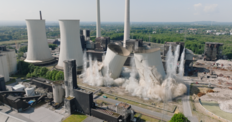
Demolition
The cooling towers D and E (114 m) at Gelsenkirchen‑Scholven were demolished today at 11:00 via controlled implosion; roughly 15,000 tonnes of concrete will be processed on‑site and recycled as backfill. Earlier demolitions at Scholven included towers G and H (2008, 2015) and tower F with associated equipment last year.
Planned replacement
A hydrogen‑capable combined‑cycle gas turbine (CCGT) plant is planned for the cleared site and is earmarked to participate in the proposed StromVKG capacity auctions; the CCGT is designed to be capable of using hydrogen in the future to support decarbonization and grid reliability.
Ammonia cracking demo
In cooperation with thyssenkrupp Uhde, Uniper is developing an ammonia demonstration cracker to convert imported ammonia into hydrogen, with the objective of scaling the technology to support up to six commercial plants linked to the Wilhelmshaven import terminal.
Safety and logistics
Thüringer Sprenggesellschaft executed the demolition with Regrata, coordinating a comprehensive safety concept with the city of Gelsenkirchen, grid operator Amprion and other stakeholders; a >300 m exclusion zone was enforced, two local roads were temporarily closed, residents were informed in writing and no evacuations were required.
Source: Uniper