
POSCO HOLDINGS completes upstream of second Argentina brine lithium plant, enabling 50,000‑ton hydroxide system

Key highlights
  • Plant 2 upstream completed with a $954 million investment and 23,000 t/year lithium carbonate capacity.
  • Combined commercial carbonate capacity in Argentina (Plants 1 and 2) is now 48,000 t/year (Plant 1: 25,000 t; Plant 2: 23,000 t).
  • A downstream plant at Yulchon scheduled for completion in 2027 will convert output to 25,000 t/year battery‑grade lithium hydroxide, completing a 50,000 t/year hydroxide system.
  • Plans for Plants 3 and 4 (25,000 t each) target a 100,000 t brine lithium production system by 2033, backed by an MOU with Salta and Catamarca and a $700 million short‑term facility approved by IDB Invest.
Related projects For subscribers
Milestones, plant data, involved companies (owners, investors, licensors, contractors) and news — kept up to date.
POSCO Argentina Sal de Oro Brine Lithium Plants · Argentina
Operational / Completed
2022
2022-03-23
2024-10
POSCO Yulchon Lithium Hydroxide Conversion Plant · Korea (South)
Under Construction
2023
2023-06-13
—
Operational / Completed · expected date for subscribers
POSCO Sal de Oro Lithium Carbonate Plant 4 Expansion · Argentina
Announced / Concept
2026-10-06
—
—
—
—
Operational / Completed · expected date for subscribers
+ 1 more tracked in chemXplore

Completion milestone

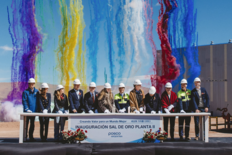
POSCO HOLDINGS completed the upstream process of its second brine lithium plant near the Hombre Muerto salt lake at roughly 4,000 meters above sea level, marked by a ceremony on October 6 attended by company executives and Argentine officials.

Capacity and timeline

Plant 2 was finished with a $954 million investment and has an annual lithium carbonate capacity of 23,000 tons. Together with Plant 1 (25,000 t/year), POSCO’s Argentina commercial carbonate capacity is 48,000 t/year. Converting Plant 2 output through a downstream facility at the Yulchon Industrial Complex, scheduled for completion in 2027, will produce 25,000 t/year of battery‑grade lithium hydroxide and complete a brine‑based 50,000 t/year hydroxide system.

Financing and approvals

POSCO‑Argentina secured approval under Argentina’s RIGI incentive regime and obtained approval for a $700 million short‑term credit facility from IDB Invest to support funding and operations.

Next steps and strategy

The company plans Plants 3 and 4, each with 25,000 t/year carbonate capacity, to reach a 100,000 t brine lithium production system by 2033. POSCO‑Argentina signed an MOU with the provincial governments of Salta and Catamarca to advance those projects, and the CEO personally inspected Plant 2 and reviewed expansion plans under the group’s “Triple‑Core” resource strategy.

Source: POSCO

chemXplore Weekly

The week’s project milestones and project news from the chemical industry, free every Wednesday.

Free. One email a week. Unsubscribe any time.

Related articles

2 September 2026
POSCO Holdings secures US$700 million IDB Invest facility for Argentine lithium operations

US$700m short-term facility to finance working capital for two brine lithium plants; preferential tax treatment will lower borrowing costs and improve project competitiveness.

14 November 2025
POSCO Holdings invests KRW 1.1 trillion in Australian and Argentine lithium assets

Invests KRW1.1T to secure Australian hard‑rock and Argentine brine lithium: 30% stake giving 270,000 t concentrate/year (~37,000 t LiOH) and full buyout of Hombre Muerto adjacent rights

13 October 2026
POSCO Future M agrees KRW 6 trillion LFP supply contract with Samsung SDI

Long-term deal more than doubles prior volumes, expands supply from NCA to LFP, LMO and synthetic graphite, and secures non‑PFE materials for buyers.

12 October 2026
Trafigura agrees 10-year offtake for 100,000 t of battery-grade lithium from EnergyX

Covers carbonate from Antofagasta and hydroxide from Texas; Trafigura takes 66% of Black Giant Phase 1 and 30% of Lonestar Phase 1, aiding US supply chain and project financing.

7 July 2026
Nobian launches LiSA pilot to scale circular low‑carbon lithium refining

Pilot will test salt-assisted crystallization to refine LiCl from geothermal brines and recycled batteries into battery-grade lithium with lower energy, CO₂, water and waste.