
MGC Participates in Japan's First Ship-to-Ship Methanol Bunkering in Yokohama
- Japan's first ship-to-ship methanol bunkering was completed at Yokohama Port.
- The operation used biomethanol from MGC's Niigata Plant.
- The project involved MGC, Yokohama City, Kokuka Sangyo, Idemitsu Kosan, and MOL.
- MLIT established methanol bunkering standards from 2024 to 2025.
Overview
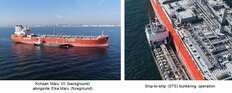
On February 9, 2026, Japan completed its first ship-to-ship methanol bunkering operation at Yokohama Port. This initiative involved Mitsubishi Gas Chemical Company, Inc. (MGC), the City of Yokohama, Kokuka Sangyo Co., Ltd., Idemitsu Kosan Co. Ltd., and Mitsui O.S.K. Lines, Ltd. (MOL).
Operation Details
Methanol fuel was transferred from the Eika Maru, a coastal methanol transport vessel operated by Kokuka Sangyo, to the Kohzan Maru VII, a dual-fuel, ocean-going methanol-transport vessel operated by MOL. Both vessels are chartered by MGC. The operation utilized domestically produced biomethanol from MGC’s Niigata Plant.
Methanol as a Marine Fuel
Methanol is recognized as a clean-burning fuel, emitting low levels of CO2, sulfur oxides, nitrogen oxides, and particulate matter. It is gaining attention as an alternative to heavy fuel oil in the shipping industry due to its ease of handling within existing infrastructure. Methanol from non-fossil sources enables carbon-neutral marine transport.
Regulatory Framework
The Ministry of Land, Infrastructure, Transport and Tourism (MLIT) established standards for methanol bunkering procedures and safety measures through the “Study Group on the Formation of Methanol Bunkering Hubs” from 2024 to 2025. The successful operation was based on findings from a methanol bunkering simulation conducted in Yokohama Port in September 2024.
Source: MGC