
Toray's 150°C inverter test with heat‑resistant film capacitor
- Tested a prototype inverter at 150°C using a film capacitor with Toray’s proprietary heat‑resistant dielectric.
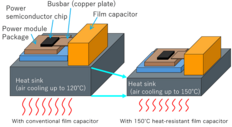
- Thermal simulations indicate the heat‑dissipation structure size could be halved when using the 150°C film capacitor.
- Joint research with Nagoya University (Prof. Masayoshi Yamamoto) validated stable high‑temperature operation.
- Work is supported by NEDO (fiscal 2023 project); Toray aims for commercialization and will exhibit at CEATEC 2026 (Oct 13–16).
Test overview
Toray announced a successful test of an inverter operating at 150°C using a prototype film capacitor that incorporates a proprietary heat‑resistant film as the dielectric.
Performance and simulation
Joint research with Professor Masayoshi Yamamoto of Nagoya University’s Institute of Materials and Systems for Sustainability showed the capacitor performed stably in a prototype inverter under high‑temperature conditions. Thermal simulations demonstrated potential to halve the size of the heat‑dissipation structure; Toray based this calculation on estimated reductions for a power control unit (as of September 30, 2026).
Context and applications
Electrification of vehicles and next‑generation mobility (including flying cars) increases demand for higher‑temperature film capacitors because smaller, lighter heat‑dissipation structures are critical to extending range and reducing weight. NEDO’s project aims to develop dielectric film for 150°C film capacitors to enable air‑cooled power control units for such applications.
Collaboration and next steps
The effort is supported by the New Energy and Industrial Technology Development Organization and will continue with development and evaluation toward commercialization of 150°C capacitors. Toray plans to exhibit the technology at NEDO’s booth at CEATEC 2026, October 13–16.
Source: Toray