
SK Innovation develops lithium-engineered catalyst for e-SAF hydrogen production
- In a 5 cm² MEA, the Ni–Fe–W–Li anode required 1.70 V at 2 A cm⁻² and 1.78 V at 3 A cm⁻², versus 1.76 V and 1.88 V for RuO₂.
- The catalyst degraded 0.58 mV per cycle over 5,400 start-up and shutdown cycles and 0.35 mV per cycle over 2,700 current-ramp cycles.
- The catalyst showed negligible decay during 500 hours of continuous operation.
- IATA projects SAF output of about 2.4 million tonnes in 2026, compared with roughly 500 million tonnes per year needed by aviation to reach net-zero by 2050.
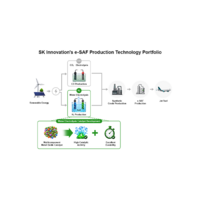
Catalyst design
SK Innovation researchers incorporated a trace amount of lithium into nickel–iron–tungsten oxide to create a Li-engineered Ni–Fe–W catalyst for anion-exchange membrane water electrolysis (AEMWE). Calculations and experiments indicated that lithium promotes the lattice-oxygen mechanism while strengthening hydroxide adsorption, helping refill oxygen vacancies and limit metal dissolution and structural damage.
Device performance and durability
In a 5 cm² membrane electrode assembly, the anode required 1.70 V at 2 A cm⁻² and 1.78 V at 3 A cm⁻², compared with 1.76 V and 1.88 V for a commercial RuO₂ benchmark. It degraded by 0.58 mV per cycle over 5,400 start-up and shutdown cycles and 0.35 mV per cycle over 2,700 staircase current-ramp cycles, with negligible decay over 500 hours of continuous operation.
Role in e-SAF production
The green hydrogen produced can be combined with carbon monoxide to form syngas, which is converted to synthetic crude and then refined into e-SAF. SK Innovation says it holds patented technology across this chain, including water electrolysis, CO₂ electrolysis, synthetic crude synthesis, and e-SAF refining and conversion.
Market context
IATA projects global SAF output of about 2.4 million tonnes in 2026, compared with approximately 500 million tonnes per year needed for aviation to reach net-zero by 2050. e-SAF is expected to account for more than 40% of global SAF production potential by mid-century.
Source: SK Innovation